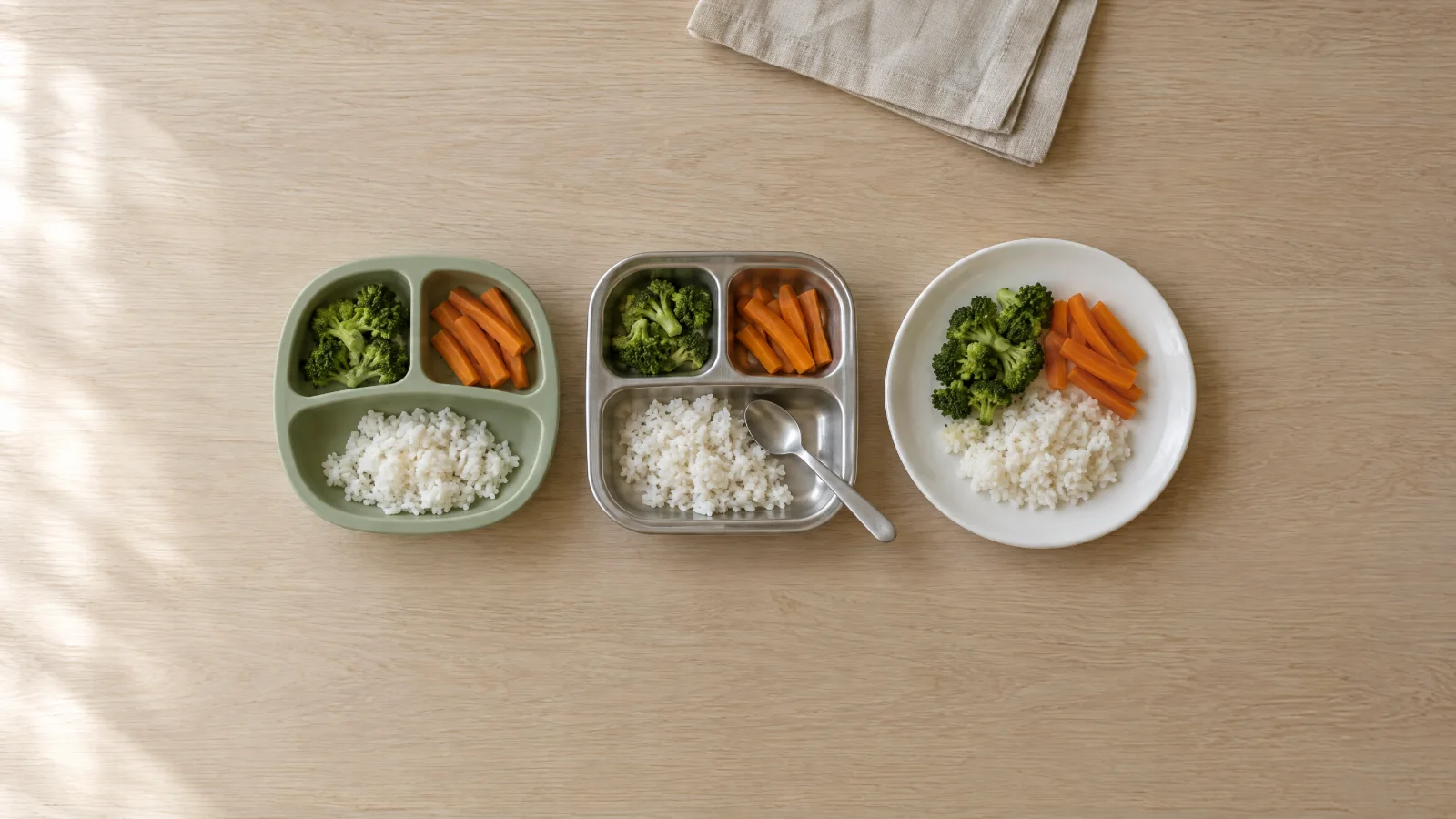
Porcelain and stainless steel absorb nothing, but only porcelain also goes in the microwave. Silicone is the safest to drop, yet over months it takes on oil, food smells and the taste of dish soap. Porcelain’s one weakness is that it can chip or break on a hard floor.
Walk down the baby aisle and nearly every toddler plate is one of two materials: silicone or stainless steel. Both earned their place. Neither breaks, neither contains BPA, and both go in the dishwasher. Their trade-offs show up later, after a few months of daily meals: a smell that won’t wash out, a clang at every bite, a leftover that can’t be reheated on the plate it was served on.
We make porcelain plates, so we have a side. We have tried to be fair anyway, including about the one thing porcelain does worse than both.
The short answer
- Silicone is soft, safe to drop and usually microwave safe. Over time it takes on oil, food smells and the taste of dish soap.
- Stainless steel is close to indestructible and rinses clean. It is loud under a spoon, cannot go in the microwave, and looks more like a cafeteria tray than a family plate.
- Porcelain absorbs nothing, goes in the microwave and the dishwasher, and looks like real tableware. It can chip or break if it falls on a hard floor.
Side by side
| Silicone | Stainless steel | Porcelain | |
|---|---|---|---|
| Takes on oil and food smells | Yes, over time | No | No |
| Can taste of dish soap | Yes, especially with scented detergent | No | No |
| Stains from tomato, carrot or turmeric | Often | No | No |
| Microwave | Usually yes | No | Yes, if it has no metallic trim |
| Dishwasher | Yes | Yes | Yes |
| Sound under a metal spoon | None | A sharp clang and scrape | A soft clink |
| If it falls on a hard floor | Bounces | Dents | Can chip or break |
| At the table | Looks like a toy | Looks like a cafeteria tray | Looks like the family’s own dishes |
Silicone: safe to drop, but it holds on to things
Silicone’s weakness is chemistry, not how you wash it. Researchers describe silicone as “highly lipophilic”: it attracts fats and oily compounds, and it “sequesters” the organic chemicals it comes into contact with. The property is reliable enough that scientists at Oregon State University turned plain silicone wristbands into personal chemical samplers, and the bands can pick up more than 1,500 organic chemicals, fragrances among them (Howe et al., American Journal of Human Biology, 2026).
At the sink the same thing happens on a smaller scale. Butter, cheese and avocado leave oil behind; scented dish soap and dishwasher detergent leave fragrance. Consumer Reports puts it plainly: silicone is “nonporous, at least on a larger scale,” but not completely. A housewares executive the magazine interviewed said that when silicone changes the taste of food, the most common cause is built-up oil residue.
Baking the plate or soaking it in vinegar helps for a while. It does not change what silicone is. We go through the six problems parents run into most, and what helps, in The Downsides of Silicone Baby Plates.
Stainless steel: indestructible, but loud and not for the microwave
Steel’s problems are the ones you hear, and the ones you notice at six in the evening. A metal spoon on a steel plate clangs, and scraping up the last of the rice makes the kind of sound that sets teeth on edge. For a child who is sensitive to noise, that can be the end of the meal.
Steel also can’t go in the microwave. The U.S. Department of Agriculture’s Food Safety and Inspection Service lists metal pans among the containers that are not safe to use in a microwave oven (USDA FSIS). Every reheated leftover means a second dish.
You may have read that stainless steel leaches nickel. In a 2013 Oregon State University study, tomato sauce cooked with stainless steel at 85 °C had up to 26 times as much nickel after six hours, depending on the grade of steel. That was hours of cooking an acidic sauce; a plate holding lunch is a far shorter, cooler contact, and plates were not tested. It matters most for children with a nickel allergy. More in The Downsides of Stainless Steel Kids’ Plates.
Porcelain: nothing soaks in, and the trade is that it can break
Porcelain is fired until the clay vitrifies. The Harmonized System notes used to classify goods at customs describe porcelain and china as “almost completely vitrified, hard, and are essentially impermeable,” and a vitrified ceramic is defined as not porous, with water absorption of 0.5% or less (Canada Border Services Agency, Memorandum D10-14-67).
In practice that means oil rinses off, last night’s curry doesn’t come back at breakfast, and there is nothing for dish soap to settle into. Porcelain can go in the microwave as long as it has no gold or silver decoration; the USDA lists “China with metallic paint or trim” as not safe to use. Two more things to check: the glaze should have passed lead and cadmium testing, and any artwork should be in or under the glaze, not painted on top.
The honest trade: porcelain can chip or break on a tile floor. That is why ours sits in a silicone base that holds it steady, and why we suggest porcelain once a child has mostly stopped throwing dishes.
Which should you choose?
- Silicone for travel, the diaper bag and the first months of self-feeding, when plates still go overboard.
- Stainless steel for camping, picnics and anywhere a break is not an option.
- Porcelain for the everyday kitchen table: meals you reheat, foods with oil and strong smells, and a child who is ready for real dishes.
Plenty of families end up with two: porcelain at home, something unbreakable for the road. The surface your child eats from every day is the one worth getting right.
Which is better for toddlers, silicone or stainless steel plates?
Each solves a different problem. Silicone is soft and usually microwave safe, but it takes on oil, smells and soap taste over time. Stainless steel absorbs nothing and survives anything, but it is loud and cannot go in the microwave. Porcelain avoids both sets of problems; its trade is that it can break on a hard floor.
Why does my silicone plate still smell after washing?
Silicone attracts oily compounds, so oil from food and fragrance from dish soap work their way into the surface. A four-hour soak in equal parts water and white vinegar, or baking an oven-safe, 100% silicone plate at about 250 °F (120 °C) for 20–30 minutes, usually helps for a while, according to Consumer Reports.
Can stainless steel kids’ plates go in the microwave?
No. The USDA lists metal pans among the containers that are not safe to use in a microwave oven. Warm the food in a microwave-safe dish first.
Is porcelain safe for toddlers if it can break?
Choose porcelain that has passed lead and cadmium testing, set it in a base that holds it steady, and bring it out once your child has mostly stopped throwing dishes. Seated, supervised meals are where it belongs.
Keep reading
- Why Silicone Baby Plates Smell and Taste Like Soap
- The Downsides of Stainless Steel Kids’ Plates
- Which Kids’ Plates Can Go in the Microwave?
- Are Ceramic Plates Safe for Toddlers?
The plate this series is about. okiboo’s 8-inch divided porcelain toddler plate sits in a flat silicone base that holds it steady without suction cups, then lifts off and covers the plate for the fridge. Lab-tested for lead and cadmium, microwave and dishwasher safe.