Description
The first real plate. Silicone holds on to soap and food oils; porcelain holds nothing. Rinse, done — and it stays put without suction cups.
One base that does two jobs
The plate sits inside a food-grade silicone base. While your child eats, the base holds it steady and stops the plate skidding — friction, not suction. When the meal ends, lift the plate out, turn the base over and press it onto the rim — it covers the plate for the fridge, so you are not transferring food into a second dish.
It is a cover, not an airtight container. Food keeps for a meal or two, not for days.
Why porcelain and not plastic
Porcelain is fired twice, the second time at 1,200–1,300 °C, until the clay vitrifies. Vitrified means non-porous — closer to glass than to pottery. Tomato sauce does not stain it. Yesterday’s dinner does not linger in it. There is no resin, no binder and no BPA, which is what plastic, melamine and
bamboo-fibre plates are held together with.
Unlike melamine, it is microwave safe. Unlike bamboo fibre, it does not swell in the dishwasher. Unlike silicone, it does not hold the smell of dish soap.
Friction, not suction
There is no suction cup, and we would rather say so before you buy. The base is flat silicone, and the heft of the porcelain presses it down, so there is nothing to loosen or peel. It makes the plate hard to push around, though not impossible to move, and it lifts off easily when you want it to. It works best on smooth trays and tables; on rough wood or a textured placemat it holds less well.
Will the artwork wear off?
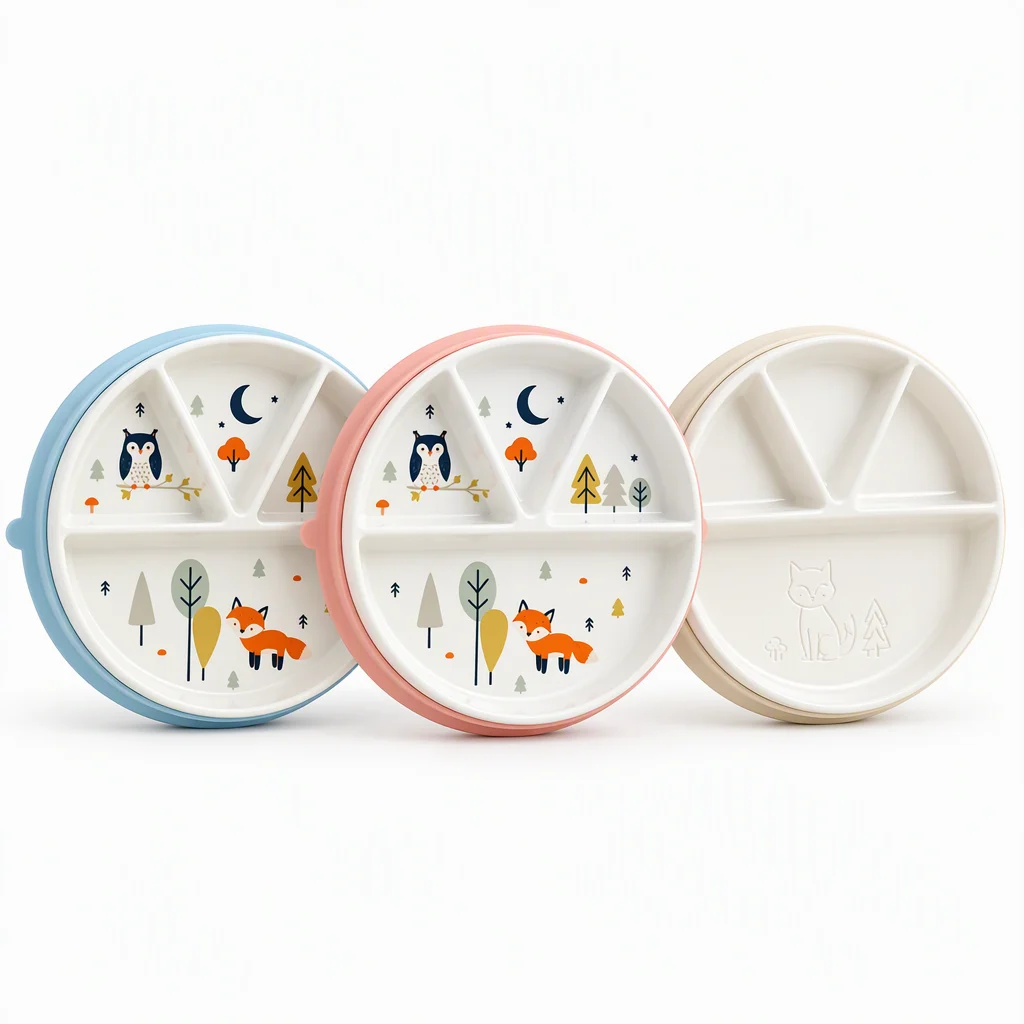
No. Forest Friends is an in-glaze decal, fired at 1,100–1,300 °C so the artwork fuses with the glaze and sits level with the surface. There is no raised layer for a fork to catch and no dishwasher cycle wears it away. Printed-on artwork, which most decorated children’s plates use, is what fades.
Ivory Cloud carries the same fox pressed into the clay rather than printed.
You feel it more than you see it.
Specification
Material — vitrified porcelain, lab-tested for lead and cadmium
Base — food-grade silicone, flat underneath, no suction cup; doubles as a cover
Diameter — 8 inches across
Weight — plate 1.4 lb (650 g), light for porcelain and enough to stay put; with base 1.7 lb (780 g)
Age — best from 12 months, once the throwing phase passes
Sections — divided, about 1 inch deep
Care — microwave and dishwasher safe, plate and base
Finishes — Forest Friends (Peach Whisper, Sky Mist) · Ivory Cloud
Packed — printed box, paper inside, no plastic
Who it suits, and who it does not
It suits a child who is self-feeding and past the stage of sweeping plates onto the floor — best from 12 months, once the throwing phase passes, though every child is different. If you buy it early, it is fine to put it away for a few months.
It does not suit a child still testing gravity at every meal. Porcelain has more heft than plastic, which helps it stay put, and it can break if it lands on tile. If your child throws, buy the plate later rather than sooner.
It is also not a travel plate. It is made for the kitchen table.
Care
Dishwasher, top or bottom rack. By hand, ordinary dish soap. Plate and base both go in the microwave.
Handle it the way you handle your own dishes. Porcelain chips on hard edges, so give it room on the drying rack rather than stacking it against metal.
More answers on suction, care and safety, and on why porcelain is safer to microwave than plastic.
Why does my silicone plate smell like soap?
Silicone takes oil into the material itself — food oil, and the fragrance oil in dish detergent — and holds on to it. Scrubbing cleans the surface, not what has soaked in, so the smell comes back; lemon, vinegar or boiling clears it for a while, and then it returns. Vitrified porcelain is non-porous, so nothing soaks in. Rinse it, and it is clean.
Isn’t the base silicone too?
Yes, and it never touches food while your child eats. It holds the plate and covers it. The surface your child eats from is porcelain.
Does it suction to the table?
No. There is no suction cup: the base is flat silicone, and friction plus the heft of the porcelain keep the plate in place. It is hard for a toddler to push around, lifts off cleanly after the meal, and works best on smooth high-chair trays and tables.
How heavy is it?
The plate is 1.4 lb (650 g) — light for porcelain, and enough to stay put. In its silicone base it is 1.7 lb (780 g). That is more than a plastic plate, so a young toddler may need a hand carrying it to the table.
What if it chips?
Porcelain can chip if it knocks a hard edge or lands on a tile floor. That is why it lives in its silicone base, and why it does best with a little room on the drying rack rather than pressed against metal. If a plate arrives damaged, send us a photo within 7 days and we will replace it — see shipping and returns.
What age is it for?
Best from 12 months, once the throwing phase passes. Before that, many babies still lift plates and drop them, and porcelain can break on a hard floor. After that, it stays useful into the early school years: the divided sections help while a child learns to keep foods apart.
Can I store leftovers in it?
Yes, for a meal or two in the fridge. Lift the plate out, turn the silicone base over and press it onto the rim as a cover. It is a cover, not an airtight container, so move food into a sealed container if you want to keep it longer.
Is it a good baby shower or first birthday gift?
Yes. It ships in a printed gift box packed with paper, so you can give it without rewrapping, and a child uses it from self-feeding into the early school years. One verified Amazon buyer wrote: “Perfect baby shower gift, won’t grow out of it quickly and then it is a keepsake.”