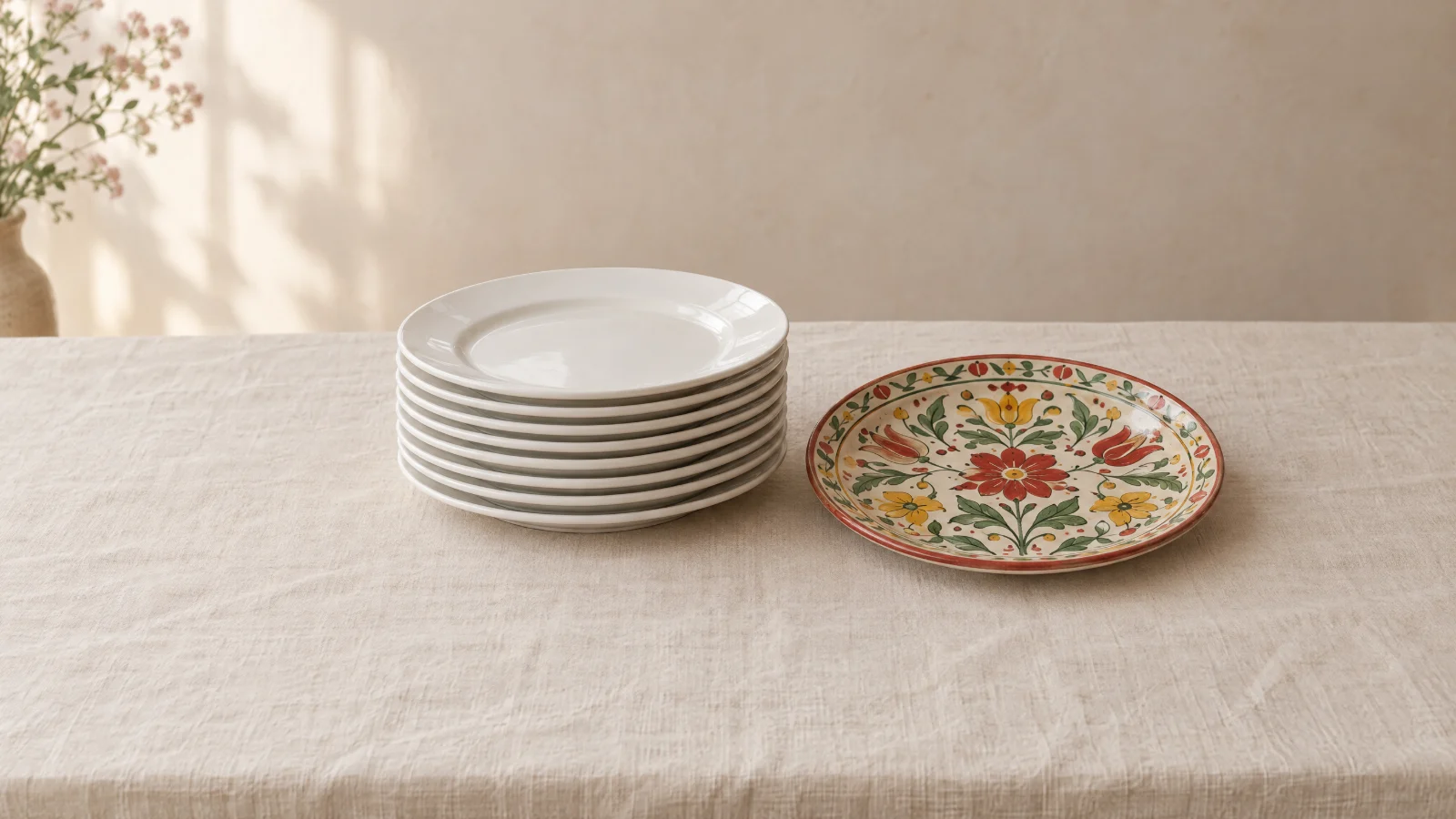
They can be, as long as the glaze has passed lab tests for lead. The main risk with any ceramic dish is lead in the glaze, which you can’t see. California’s health department says lead is “rarely found in plain white dishes” and is more likely in handmade, antique or brightly decorated pieces. Ask the maker for lab results against California’s Proposition 65 limits, and retire any plate with chipped or worn glaze.
Porcelain is clay fired until it is hard and glasslike. The part your child’s food touches is the glaze, and that is where problems can start. As the CDC puts it, “Some glazes used on ceramics, china, and porcelain also contain lead, which might get into food” (CDC). So the material itself isn’t the question. The glaze, the decoration and the condition of the plate are.
What makes a ceramic plate unsafe for a child?
The California Department of Public Health (CDPH) lists the kinds of dishes that are more likely to contain lead. Among them:
- Handmade or hand-crafted tableware, from the U.S. or abroad, unless you know what the maker’s glaze contains.
- “Antique tableware handed down in families, or found in antique stores, flea markets and garage sales.”
- Bright colors or decorations on the inside surfaces that touch food or drink.
- “Decorations on top of the glaze instead of beneath it.”
Two things raise the risk once a dish is in use. “Acidic foods and drinks leach lead out of dishes much faster than non-acid foods,” the CDPH says, and “cooking or microwaving speeds the lead-leaching process.” A report in the CDC’s MMWR on a poisoning case in New York City noted that children’s risk “is compounded by their diets, especially their frequent consumption of acidic juices” (CDC, MMWR, 2004).
The same guidance offers some reassurance: lead in glazes or decorations on the outside of a dish, away from the food, is “generally not a problem.”
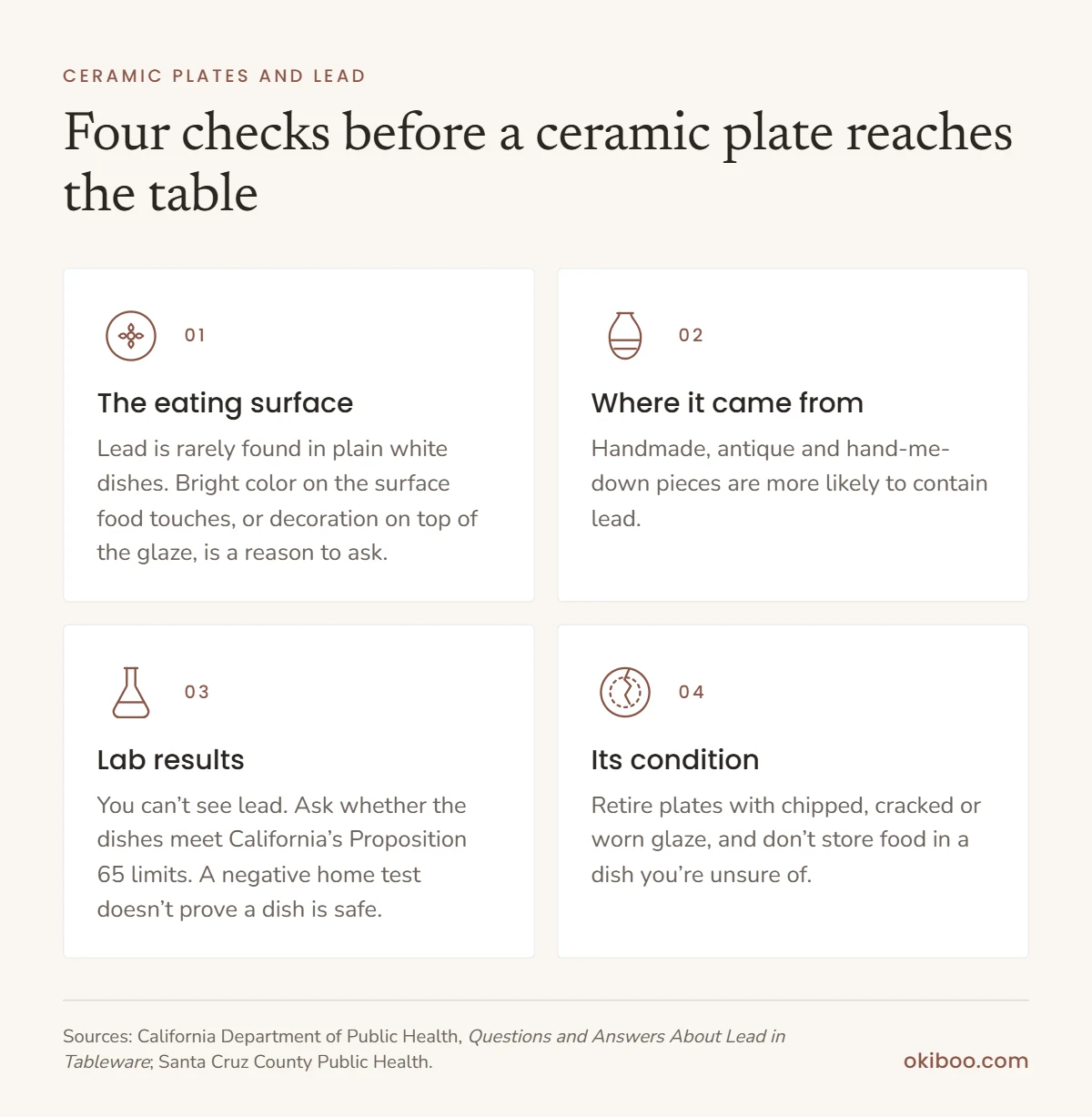
How can you check a plate before you buy it?
Not by looking. “You cannot tell for sure whether a dish has lead just by looking at it,” the CDPH says. Its advice is to “ask the manufacturer if the dishes meet Proposition 65 standards.” A maker who has tested against those limits should be able to say so, describe the lab and share the report.
The CDC is plain about what counts as proof: “Only a certified laboratory can accurately test products for lead content” (CDC).
Do home lead test kits work on dishes?
They can flag lead, but they can’t clear a dish. Santa Cruz County Public Health explains that “color-change test kits from hardware stores can indicate lead presence, but not the amount,” and puts the rule this way: “If positive, avoid using the dish for food or drinks; however, a negative result does not guarantee safety.”
If a dish does test positive, washing won’t fix it. New York City’s health department warns that “no amount of washing, boiling, or other process can remove lead from the ceramic ware” (NYC Health).
When should you stop using a ceramic plate?
When the glaze on the eating surface is chipped, cracked or visibly worn. The CDPH notes that if the surface is “chipped, cracked, or worn there may be a greater exposure to lead,” and the MMWR report on the New York case notes that “chips and cracks in ceramic ware also allow leaching of lead.” That applies to every ceramic plate, ours included. A chip can also leave a sharp edge, which is reason enough on its own to retire a child’s plate.
And don’t keep food in a dish you’re unsure of. “Do not store foods in dishes that contain or might contain lead,” the CDPH advises, because the longer food stays on a surface that leaches, the more lead it picks up.
How are OKiBoo plates tested?
Every OKiBoo colorway has passed U.S., California Proposition 65 and EU limits for lead and cadmium in tests by an independent, CPSC-accepted laboratory. The silicone base, which never holds food while your child eats, was tested separately. The report numbers and test standards are on our lab results page, and the full reports are available on request.
Can you tell if a plate has lead by looking at it?
No. California’s Department of Public Health says you cannot tell for sure by looking. Lead is rarely found in plain white dishes and is more likely in handmade, antique or brightly decorated pieces, but only a lab test shows what a glaze releases.
Do home lead test kits work on dishes?
They can show that lead is present, not how much. A positive result means the dish shouldn’t be used for food; a negative result does not guarantee the dish is safe, according to Santa Cruz County Public Health.
Should I stop using a chipped ceramic plate?
Yes, if the chip, crack or worn patch is on the eating surface. California health officials say damaged glaze may increase lead exposure from dishes that contain lead, and a chip can leave a sharp edge.
Keep reading
- Silicone vs Stainless Steel vs Porcelain Toddler Plates
- Are Bamboo Kids’ Plates Safe? The Melamine Problem
- Is BPA-Free Plastic Safe for Toddler Plates?
Our plate. OKiBoo’s 8-inch divided porcelain toddler plate sits in a flat silicone base that holds it steady on the table, then turns over to cover the plate for the fridge. Lab-tested for lead and cadmium, microwave and dishwasher safe.