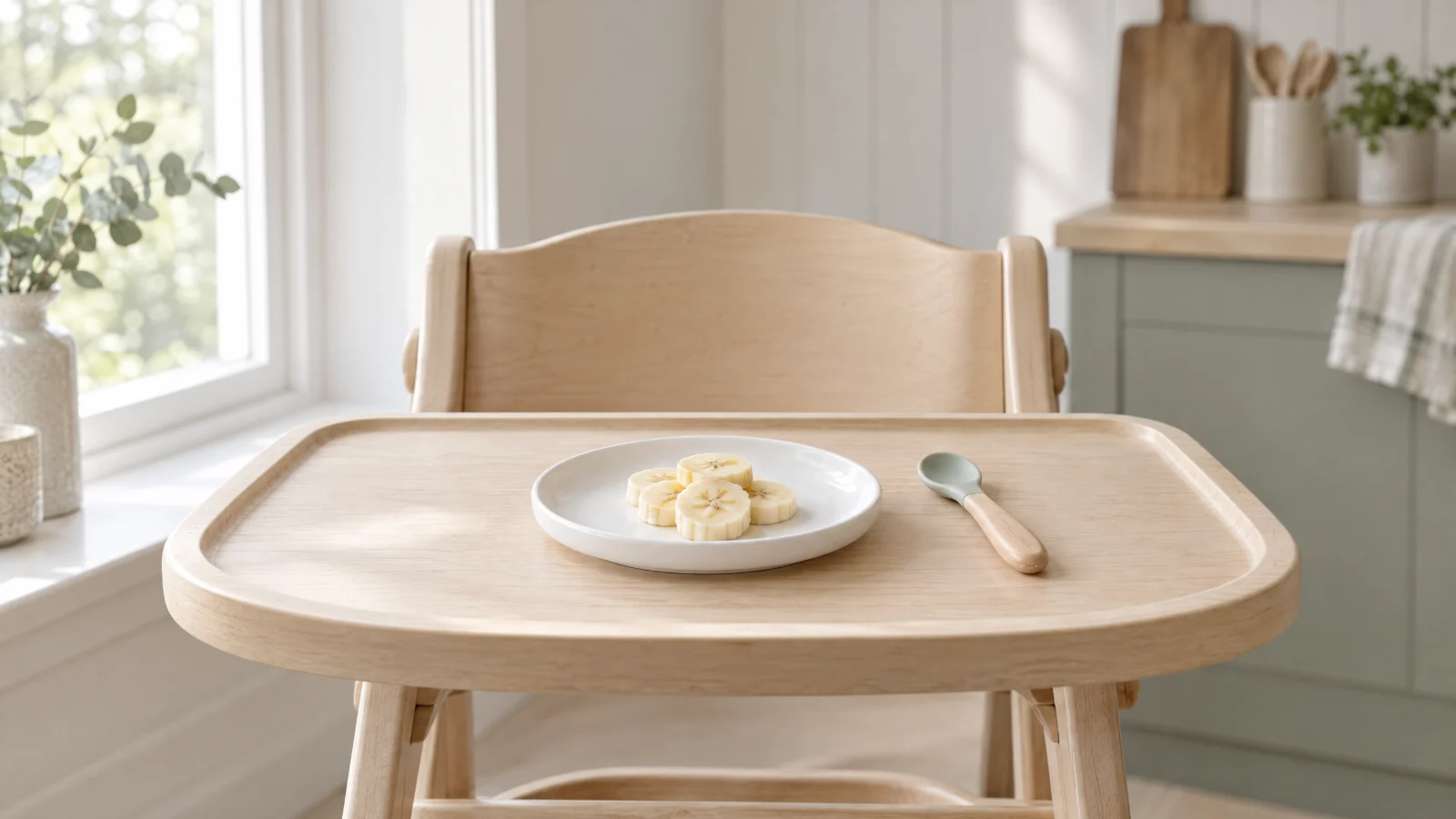
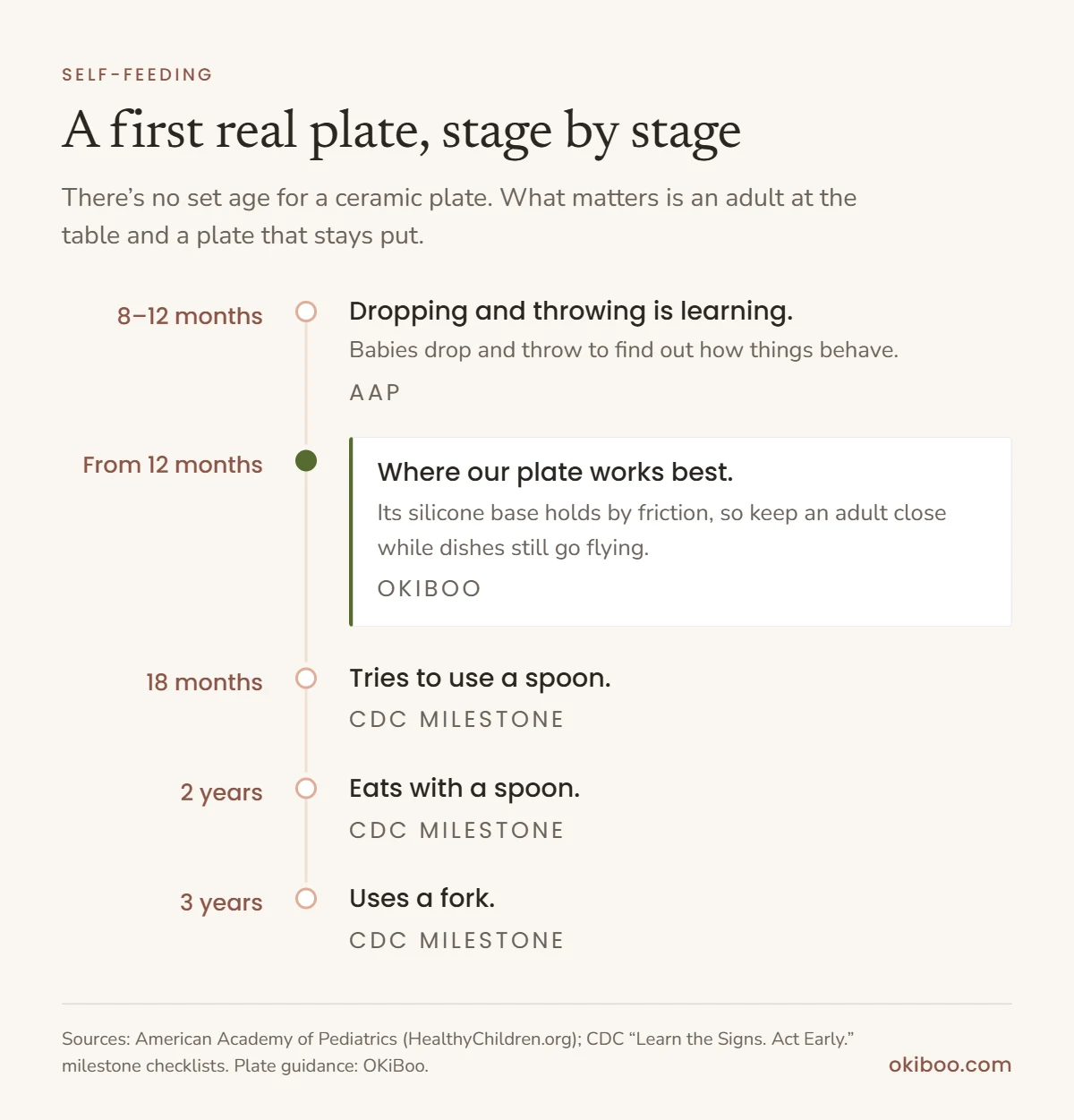
There’s no set age for a first ceramic plate; what matters is an adult at the table and a plate that stays where it’s put. OKiBoo’s plate can be used before 12 months, but it works best from about 12 months, because its silicone base holds by friction rather than suction.
Plenty of families bring out real dishes early, for the reasons set out in Should Toddlers Use Real Plates? The Montessori View: children learn to handle breakable things by handling them. The harder question is timing. Babies spend months finding out what objects do when they fall, and a porcelain plate isn’t the best tool for that particular lesson.
Can a baby under 12 months use a ceramic plate?
Yes, with an adult sitting right beside them. The CDC doesn’t address plates, but its advice at the one-year mark points the same way: “Sit next to your baby and enjoy mealtime together. Expect spills” (CDC). Put the plate within reach but back from the edge of the tray, and stay close enough to steady it.
Our plate’s base holds it in place by friction on a smooth tray or table. It isn’t designed to resist a determined pull, which is why we say it works best from about 12 months, with an adult close by.
Why do babies throw dishes, and when does it ease?
Because it’s how they learn. The American Academy of Pediatrics says that between 8 and 12 months, “your baby will never tire of dropping, rolling, throwing, submerging or waving objects” to see how they behave, adding: “This may look like random play to you, but it’s your child’s way of finding out how the world works” (AAP). By 9 months, one of the CDC’s milestones is that a baby “looks for objects when dropped out of sight (like his spoon or toy)” (CDC).
In toddlers, throwing food often means something simpler. “Throwing food usually means she is full or finished eating,” says the Minnesota Department of Health’s WIC program. Calmly ending the meal tends to work better than a big reaction. As tips credited to ZERO TO THREE put it, “stronger reactions (smiling, laughing or even anger) are a kind of reward for your baby” (Texas Health Resources).
Children differ in how long this lasts. The AAP says “some children get over this chaotic eating behavior by their second birthday,” while “others, however, will remain very messy eaters well into their third year” (AAP).
What does the AAP say about breakable dishes?
Writing about toddlers past their first birthday, the AAP’s parenting guide is clear: “Unbreakable dishes, cups, and glasses are essential, since they, too, may go flying when he’s bored with their contents” (AAP, from Caring for Your Baby and Young Child, 2009).
We agree for that stage. Unbreakable dishes make sense while plates still go overboard, and for travel and daycare. A porcelain plate is for the kitchen table, once a child mostly eats rather than tosses, with an adult close by.
What should a first real plate have?
- A tested glaze. Ask for lab results against Proposition 65 limits. More in Are Porcelain Plates Safe for Toddlers?.
- No metallic paint or trim, if it will go in the microwave. See Which Kids’ Plates Can Go in the Microwave?.
- Raised edges to scoop against. An NHS Greater Glasgow and Clyde sheet on using a spoon suggests “a bowl or plate with a raised edge so the child has something to scoop against” (NHS).
- A base that keeps it steady on a smooth tray, and a size that fits the tray.
- Dishwasher safe, because it will be washed every day.
Ours is an 8-inch porcelain plate with sections about an inch deep, in a flat silicone base that turns over to cover the plate for the fridge.
Can a baby under 12 months use a ceramic plate?
Yes, with an adult at the table. OKiBoo’s plate can be used before 12 months, but it works best from about 12 months, because its base holds by friction rather than suction. Keep an adult close by while dishes still go flying.
Do babies need unbreakable dishes?
During the throwing months, they help. The AAP calls unbreakable dishes essential while plates and cups still go flying. A ceramic plate fits once a child mostly eats rather than tosses, with an adult close by.
Why do toddlers throw their dishes?
Dropping and throwing is how babies learn how objects behave, and in toddlers throwing food often means they are full. A calm response, and ending the meal when the throwing continues, are the usual advice.
Keep reading
- Are Porcelain Plates Safe for Toddlers?
- Should Toddlers Use Real Plates? The Montessori View
- Do Divided Plates Help Picky Eaters?
Our plate. OKiBoo’s 8-inch divided porcelain toddler plate sits in a flat silicone base that holds it steady on the table, then turns over to cover the plate for the fridge. Lab-tested for lead and cadmium, microwave and dishwasher safe.